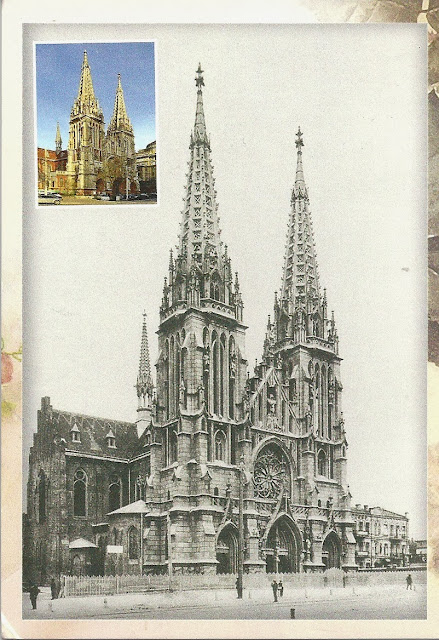
The St. Nicholas Roman Catholic Cathedral is the second Roman Catholic cathedral built in Kyiv, the capital of Ukraine. Today the building is shared between the Roman Catholic Church of Ukraine and the National House of Organ and Chamber Music. Another Catholic church, the St. Alexander Roman Catholic Cathedral, is the oldest Catholic church in the city and is located near the European Square behind the Ukrainian House in Kyiv. A competition was held in 1898 for the designs for a Roman Catholic Cathedral in Kyiv, which was won by architect S. Volovskiy. His entry into the competition included a Gothic type construction with two 60 m (197 ft) towers. The final revision and management of the project was assigned to the Kyivan architect Vladislav Gorodetsky, and Emilio Sala added sculptural decoration in artificial stone to the construction. To increase the stability of the construction on the uneven Kyiv ground, it was ensured by bore-and-stuffed piles, a newly introduced invention of Anton Strauss. The construction work was carried out by exclusively from voluntary donations, and lasted for ten years (1899–1909).
In 1909, the cathedral was consecrated in the name of Saint Nicholas, however the construction was not yet completed. A Gothic style three-story house was built in the for the parish clergy to the left of the cathedral. In 1938, Soviet authorities closed the cathedral after its Roman Catholic priest was "absent" for two years due to the Soviet persecution of Christians. For some time after its closure, the building was used by the punitive organs for technical purposes, and, at some point, served as a KGB service building. After its restoration in 1979-1980, commissioned by the Rada of Ministers of the Ukrainian SSR, by the architects O. Grauzhis and I. Tukalevskiy, the church was turned into the National House of Organ and Chamber Music of Ukraine. For the reconstruction and restoration of the severely damaged church, the building's stained glass windows were manufactured in the Baltics, its furniture was created in Lviv, and the high-quality wood floors were produced in the Ivano-Frankivsk Oblast. The company, Rieger–Kloss then located in Czechoslovakia (Sudetenland), manufactured an organ for the cathedral. Its manufacturer tried to architecturally tie the organ to the building itself. Since 1992, Catholic Masses and concerts have been held here. Bishop Jan Purvinski consecrated the cathedral and a Mass was celebrated there on 4 January 1992. Currently, it belongs to the Kyivan Municipal Department for Culture, but the Roman Catholic Church hopes it will be returned to the local Latin rite Roman Catholic community. The Kyiv city municipality refuse to hand over the building until the issue of transferring the House of Organ Music will be solved. Since 2009 the building is in emergency conditions. The religious services are performed by priests of the Missionary Oblates of Mary Immaculate. Most of the services are conducted in the Ukrainian language, while on some days services conducted in Polish, Latin and in Spanish.
About the sender
katty81 (postcrossing) sent from Kyiv (Ukraine) on 13.11.2013


